Condition Number: Intuitive notes
The setting
Say we want to solve a linear system \(A\bar{x}=\bar{b}\). We are interested in seeing how a small error in \(\bar{b}\) influences the solution \(\bar{x}\).
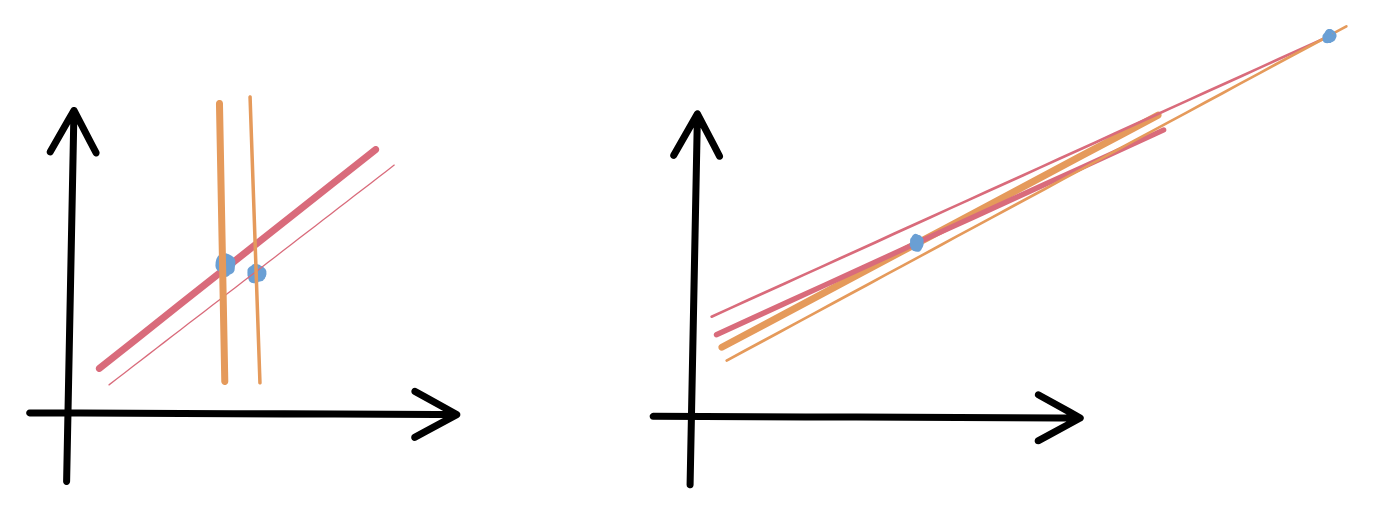
To start simple, consider a 2D problem. We want solution to two line intersection. We find the intersection point. What we now want to see is if I perturb the lines slightly, how much does the intersection point change. We can imagine that if the lines have a healthy angle between them, the intersection doesn’t change much. But if they are nearly parallel, small perturbation changes the intersection point significantly. See the diagram below:
Assuming \(A\) is invertible, we have
\[\begin{aligned} A(\bar{x}+\delta\bar{x}) &= \bar{b}+\delta\bar{b} \\ A\bar{x} + A\delta\bar{x} &= \bar{b} + \delta\bar{b} \\ \delta\bar{x} &= A^{-1}\delta\bar{b} \end{aligned}\]Multiplying by a matrix stretches and rotates the vector. \(\|M\|\) be the maximum stretch \(M\) can induce on a vector. Then
Similarly, since \(A\bar{x}=\bar{b}\), \(\|\bar{b}\| \le \|A\| \|\bar{x}\|\) or
Multiplying both:
\[\begin{equation} \frac{\|\delta\bar{x}\|}{\|\bar{x}\|} \le \underbrace{\|A\| \|A^{-1}\|}_{\kappa(A)} \frac{\|\delta\bar{b}\|}{\|\bar{b}\|} \end{equation}\]How much can \(A\) stretch?
Let \(A \in \mathbb{R}^{m \times n}\). Let’s define \(A^T A = M \in \mathbb{R}^{n \times n}\). \(M\) is a real symmetric matrix. We will spend some time analysing the properties of \(M\).
- \(\bar{x}^T M \bar{x} = \bar{x}^T A^T A \bar{x} = \|A\bar{x}\|_2^2 \ge 0\) \(\therefore M\) is positive semidefinite
- Let \(\bar{v}\) be a complex vector. Define \(c = \bar{v}^* M \bar{v}\). The (complex conjugate of \(c\)) = \(c^* = (\bar{v}^* M \bar{v})^* = \bar{v}^* M^* \bar{v}\) Since \(M\) is real and symmetric, \(M^* = M \implies c = c^*\) i.e. \(c\) is a real number
- If \(\bar{v}\) is an eigenvector, \(c = \bar{v}^* M \bar{v} = \lambda \bar{v}^* \bar{v} = \lambda \|\bar{v}\|_2^2\) \(c\) is real, \(\|\bar{v}\|_2^2\) is real, so \(\lambda\) is real
-
Let \(\bar{v}_i\) be eigenvector of \(M\) with corresponding eigen value \(\lambda_i\) \(\bar{v}_i^T M \bar{v}_i = \bar{v}_i^T A^T A \bar{v}_i = \|A\bar{v}_i\|_2^2\) \(\bar{v}_i^T M \bar{v}_i = \bar{v}_i^T \lambda_i \bar{v}_i = \lambda_i \|\bar{v}_i\|_2^2\) \(\|A\bar{v}_i\|_2^2 = \lambda_i \|\bar{v}_i\|_2^2 \implies \lambda_i \ge 0\)
- Given \(\bar{v}\), eigenvector of \(M\), \(\bar{v} \in \mathbb{R}^n\). Consider perpendicular space \(W\). Lets see what the component of \(M\bar{w}\) is along \(\bar{v}\). \(\bar{v}^T M \bar{w} = (M^T \bar{v})^T \bar{w} = (M \bar{v})^T \bar{w} = \lambda \bar{v}^T \bar{w} = 0\) So \(M\) maps \(W\) back onto itself. Consider the matrix \(M' = (M - \lambda \bar{v} \bar{v}^T)\). \((M')^T = M^T - \lambda \bar{v} \bar{v}^T = M'\). \(M' \in \mathbb{R}^{n \times n}\) is also a symmetric matrix which maps \(\bar{w} \in W\) to \(W\). If we find one eigenvector of \(M'\) such that \(M' \bar{w} = \mu \bar{w}\), we have \(M' \bar{w} = M \bar{w} - \lambda \bar{v} \bar{v}^T \bar{w} = M \bar{w} = \mu \bar{w}\), we basically found another eigenvector of \(M\) perpendicular to \(\bar{v}\). We can repeat this and we will end up with \(n\) mutually orthogonal eigenvectors of \(M\) which form basis of \(\mathbb{R}^n\).
\(V\) is orthonormal \(\Rightarrow V^T V = I \Rightarrow V^{-1} = V^T\)
\[\begin{equation} \begin{aligned} M V &= V \Lambda \\ \Rightarrow M &= V \Lambda V^T \end{aligned} \end{equation}\]Spectral theorem
- Algebraic Multiplicity = Geometric Multiplicity.
Using \(\det(AB) = \det(A)\det(B)\) when \(A\) and \(B\) are square:
\[\begin{aligned} \det(V^T V) = \det(V V^T) = \det(I) &= 1 \\ \det(V^T)\det(V) = \det(V)\det(V^T) &= 1 \\ \det(V) = \det(V^T) &\Rightarrow \det(V) = \pm 1 \\ \therefore \det\big(V (\Lambda - x I) V^T\big) &= \det(\Lambda - x I) = 0 \end{aligned}\] \[\Rightarrow \prod(\lambda_i - x) = 0\]Algebraic multiplicity is the number of times \(\lambda_i\) repeats \(\ge 1\)
Geometric Multiplicity : dimension of nullspace of \(M - \lambda_i I\).
\[\begin{aligned} \dim(\text{null}(M - \lambda_i I)) &= \dim(\text{null}(V (\Lambda - \lambda_i I) V^T)) \end{aligned}\]Since \(V\) is full rank,
\[\begin{aligned} \text{null}(V (\Lambda - \lambda_i I) V^T) &= \text{null}(V (\Lambda - \lambda_i I)) \\ &= \text{null}(\Lambda - \lambda_i I) \end{aligned}\] \[(\Lambda - \lambda_i I) \bar{x} = 0 \Rightarrow (\lambda_j - \lambda_i) x_j = 0\]Non zero \(x_j\) found when \(\lambda_j = \lambda_i \Rightarrow\) Symmetric matrix has algebraic multiplicity = geometric multiplicity
Singular Value Decomposition
Using the spectral theorem:
\[A^T A = M = V \Lambda V^T\]\(\text{rank}(M) \leqslant \min(\text{rank}(A^T), \text{rank}(A))\). \(A \in \mathbb{R}^{m \times n}\) \(\text{rank}(A) \leqslant \min(m, n)\). So \(\text{rank}(M) \leqslant \min(m, n)\).
If \(n > m\), \(\text{rank}(M) \leqslant m\)
If \(n < m\), \(\text{rank}(M) \leqslant n\)
\(M \in \mathbb{R}^{n \times n}\). From rank nullity theorem:
\[n = \text{rank}(M) + \text{nullity}(M)\]If \(M\) has zero eigenvalue with algebraic and geometric multiplicity \(K\), every vector in the subspace spanned by corresponding eigenvectors belongs to the null space of \(M\). \(\bar{x} = \sum_{i=1}^{K} \alpha_i \bar{v}_i \Rightarrow M\bar{x} = \sum_{i=1}^{K} \alpha_i \underset{0}{M\bar{v}_i} = 0\)
\(\therefore \text{nullity}(M) = K\)
Consider \(\|A \bar{v}_i\|_2^2\) where \(\bar{v}_i\) is eigenvector of \(M\).
\[\|A \bar{v}_i\|_2^2 = \bar{v}_i^T A^T A \bar{v}_i = \bar{v}_i^T \lambda_i \bar{v}_i = \lambda_i\]Lets define \(\|A \bar{v}_i\| = \sigma_i = \sqrt{\lambda_i} \quad (\lambda_i \geqslant 0)\) and the unit vector \(\frac{A\bar{v}_i}{\|A\bar{v}_i\|} = \frac{A\bar{v}_i}{\sigma_i} = \bar{u}_i\)
for every eigenvector \(\bar{v}_i\) whose corresponding eigen value is non-zero. We notice that \(\bar{u}_i\) are mutually orthogonal.
\[\bar{u}_i^T \bar{u}_j = \frac{\bar{v}_i^T A^T A \bar{v}_j}{\sigma_i \sigma_j} = \frac{\sigma_j}{\sigma_i} \bar{v}_i^T \bar{v}_j = 0\]We can use \(\bar{u}_i\) as basis of \(\mathbb{R}^m\) and complete the basis by identifying \(m - (n-k)\) or \(m - r\) more vectors which are mutually orthogonal (\(r\) is \(\text{rank}(M)\), \(K\) is nullity of \(M\)).
\[A\bar{v}_i = \sigma_i \bar{u}_i \quad, i = 1, 2, 3 \cdots n\]For \(i \leqslant r, \sigma_i \neq 0\). For \(r < i \leqslant n, \sigma_i = 0\)
\[A[\bar{v}_1, \bar{v}_2 \dots \bar{v}_n] = [\bar{u}_1, \bar{u}_2 \dots \bar{u}_m] \begin{bmatrix} \sigma_1 & & & \\ & \sigma_2 & & \\ & & \ddots & \\ & & & \sigma_r & \\ & & & & 0 & \\ & & & & & \ddots & 0 \end{bmatrix}\] \[\begin{equation} AV = U \Sigma \Rightarrow A = U \Sigma V^T \end{equation}\]What multiplying with \(A\) does?
\[A\bar{x} = U \Sigma V^T \bar{x}\]- \(V^T \bar{x}\) rotates \(\bar{x}\) as \(V\) is orthonormal
- \(\Sigma\) scales each component of a vector
- \(U\) again rotates a vector.
So if \(\sigma_1 \geqslant \sigma_2 \geqslant \sigma_3 \dots \sigma_r\),
\[\begin{aligned} \|A\bar{x}\| &= \sqrt{\sigma_1^2 x_1^2 + \sigma_2^2 x_2^2 + \dots \sigma_r^2 x_r^2 + 0 \dots 0} \\ &= |\sigma_1| \sqrt{x_1^2 + \left(\frac{\sigma_2}{\sigma_1}\right)^2 x_2^2 + \dots \left(\frac{\sigma_r}{\sigma_1}\right)^2 x_r^2 + 0 \dots 0} \\ &\leqslant |\sigma_1| \sqrt{x_1^2 + x_2^2 + \dots x_n^2} \\ &\leqslant |\sigma_1| \|\bar{x}\| \end{aligned}\]So the maximum stretch \(A\) can do is the magnitude of largest singular value of \(A\).
Condition number
When \(A\) is square and invertible,
\[\begin{aligned} A^{-1} &= (U \Sigma V^T)^{-1} \\ &= (V^T)^{-1} \Sigma^{-1} U^{-1} \\ &= V \underbrace{\Sigma^{-1}}_{\text{SVD with singular values} = 1/\sigma_i} U^T \end{aligned}\]Enjoy Reading This Article?
Here are some more articles you might like to read next: